Fungi Transform End-Of-Life Mattresses Into Lightweight Fire-Resistant Insulation
Researchers at Swinburne University of Technology have developed a bio-composite insulation material made from shredded mattress foam and mycelium. By combining discarded polyurethane foam with a common fungus, the team created a lightweight and solid material suitable for building applications.
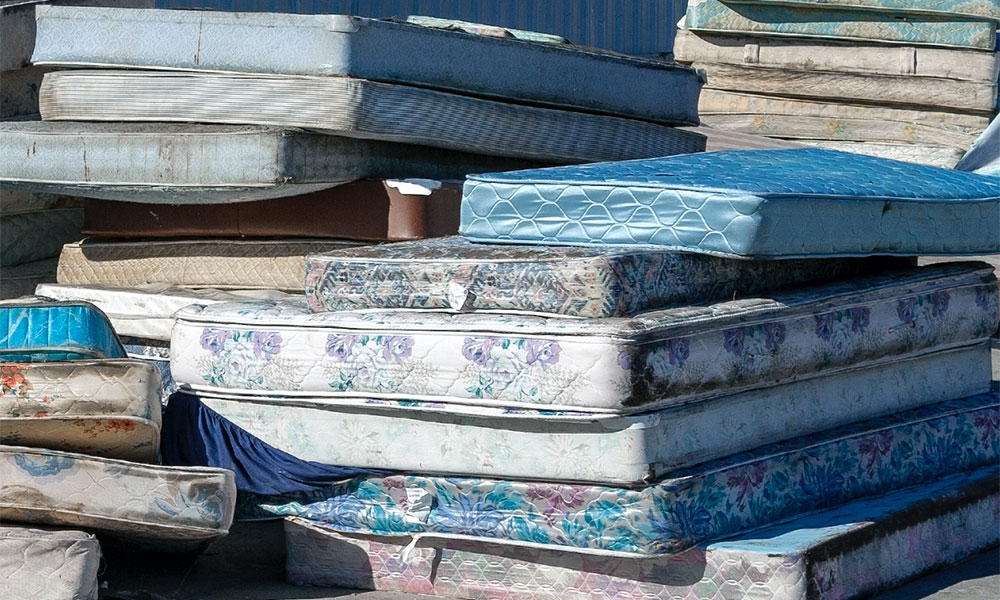
Mattresses are notoriously difficult to recycle. Because they are bulky and made from multiple materials, many still end up in landfill. In Australia alone, around 1.8 million mattresses are discarded every year. Of these, approximately 740,000 go to landfill. This equals roughly 22,000 metric tonnes of waste, and each mattress can take up to 120 years to decompose.
Instead of sending this waste to landfill, the researchers use it as a feedstock. In doing so, they demonstrate how biological processes can support circular construction.
A Circular Bio-Composite For Sustainable Architecture
The innovation lies in how the mycelium grows through the shredded foam. As it spreads, the fungal network binds the particles together. At the same time, it forms natural mineral compounds that strengthen the structure. The result is a cohesive, lightweight bio-composite.
Importantly for architects and interior designers, the material performs well as thermal insulation. Tests show that its heat-blocking capacity comes close to that of conventional insulation products used in buildings. Moreover, the composite remains stable at temperatures approaching 1,000°C. This high heat resistance suggests strong potential for fire-resistant insulation systems.
The researchers selected a fungus closely related to strains used in food production and medicine. As a result, the biological component is well understood. The process also relies on widely available chemicals, which may support future scaling.
From Insulation To 3D Printed Building Elements
With further development, this mycelium-based material could serve more than one function. For example, designers could use it for fire-resistant building panels or prefabricated components. In addition, its compatibility with emerging fabrication methods opens new possibilities. The team even suggests future use in 3D printed construction elements.
The project highlights the value of combining waste streams with bio-fabrication. Rather than relying on virgin resources, the system upgrades existing polymer waste into a higher-value building material.
Overall, this research shows how fungi can help close material loops in the built environment. By merging biology, waste recovery and manufacturing science, it points towards low-impact, circular building materials with real performance potential.
Source: Swinburne University of Technology, via Scientific Reports
Photo: Circularonline.co.uk

Comments