Articles

The world’s first tall building made of engineered bamboo
At Zhejiang University in China, a 6-storey building is constructed, consisting of mostly engineered bamboo, the first multi-storey building of this material. The building has a total hight of 20.3 metres and a floor area ...
Read more >
A transparent metamaterial for energy-efficient light and temperature regulation
Researchers at the Karlsruhe Institute of Technology (KIT) developed a metamaterial that allows sunlight to enter, maintains a more comfortable indoor climate without additional energy, and cleans itself. The maximising of natural light in a ...
Read more >
A modular wind energy system made of recycled materials
The company Airiva developed a modular, scalable and smart wind energy system consisting of an array of vertical wind turbines, made of recycled materials. Generally, wind turbines are long poles with three blades attached to ...
Read more >
A sound-suppressing silk fabric
Researchers at MIT in the US developed a thin silk fabric that can be used to create quiet spaces. There are many acoustic materials on the market, creating less noisy and therefore more pleasant surroundings. ...
Read more >
3D clay printed tiles inspired by Delft Blue porcelain
Dutch design studio Studio RAP has reinterpreted the design of Delft Blue porcelain, by creating 3000 unique, 3D clay printed tiles, which were installed in Delft, the Netherlands. Called New Delft Blue, the project, which ...
Read more >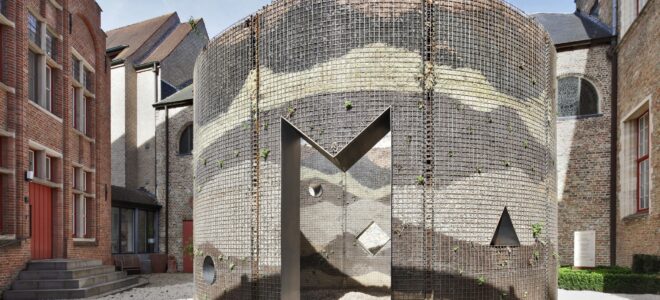
A pavilion made of metal grid and various material layers
As part of Bruges Triennial, Rotterdam-based Studio Ossidiana designed a pavilion consisting of a cylindrical metal grid, filled with various materials, including earth, peat and shells, to create substrata, as seen in archaeological surveys. Called ...
Read more >