MaterialsStoriesBrandsEventsBooksTalksChannels
← Stories
Material FuturesSmart & Responsive

Metamaterials: a whole new world

News · Story by MaterialDistrict · 9 Apr 2014 · 1 min read

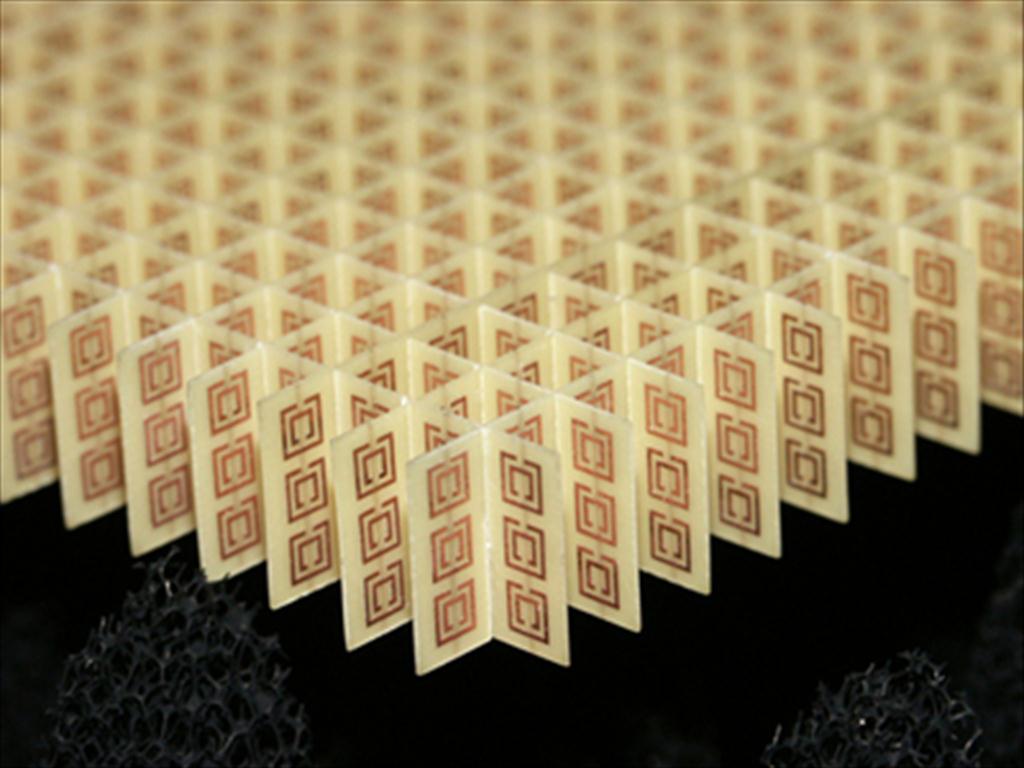
We’ve written about smart materials, which are impressive as they add novel functionality to materials we know well. A newer class of materials is so stunning that they could blow the likes of smart materials out of the water. Metamaterials are literally starting to shape a whole new world.

Such materials can bend light, sound and even seismic energy – in fact, anything that travels in waves can be manipulated.

Metamaterials are extremely high-tech, but they are based on a very simple principle: they are built at a scale that is smaller than the wave-length of whatever they are manipulating.

To understand how they work, consider waves on the sea surface. Waves that are about the size of a boat make the vessel bob up and down. Very large ships are generally not affected much by waves. Tiny floating objects aren’t bothered by waves at all. Importantly, the reverse is also true: the wave carries on, undisturbed by the tiniest objects.

So imagine a material that is made up of plastic organised on a nano-scale. By playing with the plastic used, researchers at DukeUniversity have created cloaking materials that let light pass around an object. The effect is an invisible material.

Of course, this has attracted the attention of defence industries. In architecture, the technology could be used to make structural supports ‘disappear’ or to make a room look like it’s all window.

The technology isn’t limited to light. Another promising metamaterial application is to use them to steer seismic waves around a building to stop earthquake damage. Meanwhile, smart phone producers are quietly incorporating metamaterial technology into the next generation of phones. Applications already include highly-efficient wireless charging.

More information on intriguing metamaterials is here.

Images courtesy of Duke University.

MDMaterialDistrict9 Apr 2014 · 1 min read
Enjoyed this story?Make MaterialDistrict a preferred source — see our stories first in Google.
Make MaterialDistrict your preferred source
Latest materials
  • Mush Surfaces – Bio-Lithic EditionMush Composites
  • ‘Carbon Capture’ tilesStudio Jesper Eriksson
  • OBRO – Leather-Infused Translucent PVC CompositeOkunote
All materials →

Follow the Transition

Choose your topics and stay updated on the innovations shaping a sustainable built environment.

Email updates:
Unlock all articles
Read every in-depth story

Insiders read every in-depth article, get quarterly trend reports and 1 free event entry per year.

Become an Insider — €10/mo

Related

  • ArticleRecreating the structure of a conch shell by 3D printing on World Oceans Day
  • ArticleNew material source meets new technique
  • ArticleStretchable Metamaterials: A New Frontier in Durable, Flexible Design
  • ArticleMorphing pasta as new metamaterial
  • ArticleNew metamaterial based on Japanese art of kirigami
  • ArticleNoah: the world’s first circular car
MaterialDistrict
The leading platform for innovative and sustainable materials — for architects, designers and manufacturers.

Choose your topics and stay updated on the innovations shaping a sustainable built environment.

Discover
MaterialsStoriesEventsTalksBooksBrands
For specifiers
Create free accountInsider membershipCompare materialsBoardsInsider insights
For manufacturers
List your materialsBrand profileReach 80,000+ specifiersSample requestsInnovation Fund
Company
About MaterialDistrictOur missionFrequently asked questionsContact
Contact
info@materialdistrict.com+31 (0)20 71 30 650
MaterialDistrict B.V.
Amsterdamsestraatweg 43-A2
NL-1411 AX Naarden
The Netherlands
Company Number 60837802
VAT Number NL854081732B01
LinkedInInstagramX
© 1998 – 2026 MaterialDistrictAdd MaterialDistrict to Google
Privacy policyAccessibilityCookiesTerms of use