3D Printed Insulation Panels Made to Measure on Site
Imagine facade insulation that is printed where it will be used: lightweight hexagonal tiles, each small enough to lift with one hand. At the Hamburg University of Technology (TUHH), a team is developing exactly that with the engineering firm TECCON Consulting & Engineering. The panels are still at prototype stage, and a feasibility study from 2025 has produced promising results.
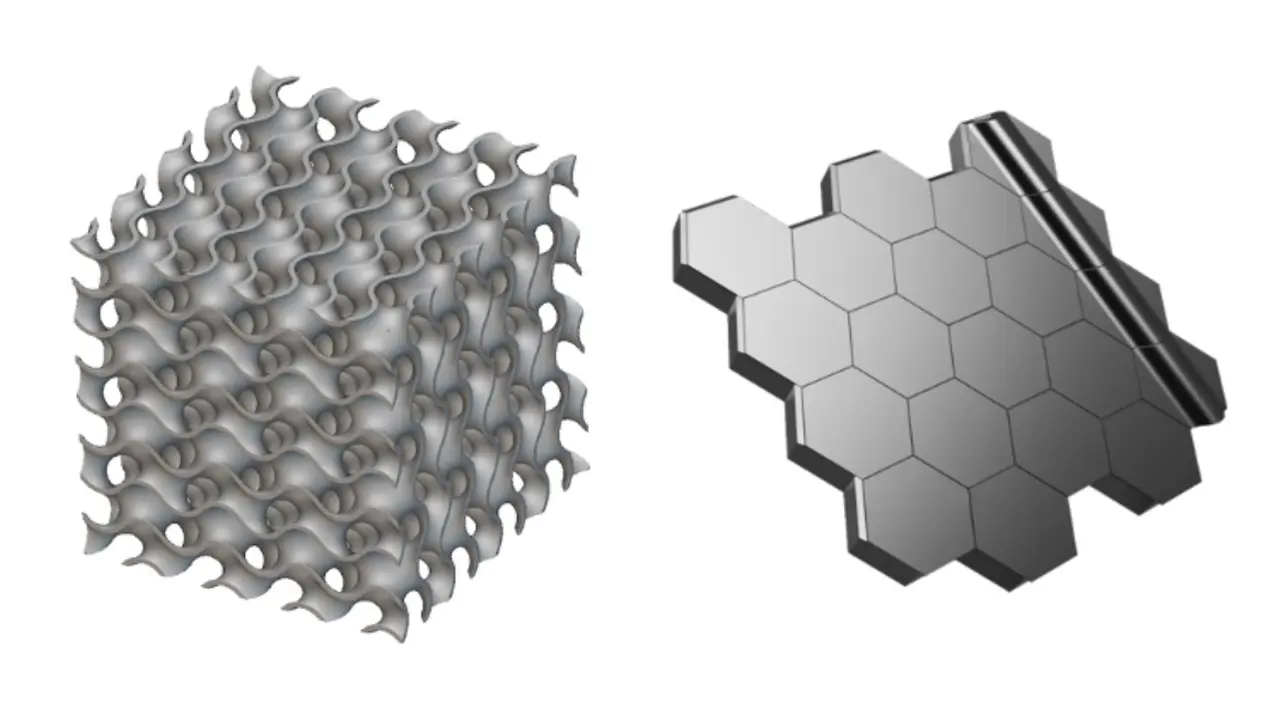
A Lattice That Traps Air in Every Panel
The designs are based on TPMS structures, short for triply periodic minimal surfaces. Their smooth, continuous curves spread stress evenly, so there are no weak points at the joints, as there are in conventional lattices. They use little material and enclose a large volume of air, which is what makes them suited to insulation. Structures this complex can only be made by additive manufacturing.
Some of these structures enclose two separate spaces. One could be left filled with air, the other packed with an insulating material such as hemp. Project leader Maximilian Keller points out that hemp fibres also strengthen the structure and are fully biodegradable.
The team develops designs and processes, not the materials themselves. Keller calls the approach “insulating through design”.
Photo: TUHH
Sized for One Person on the Scaffold
Panel size is a balancing act. A panel has to be light enough for one worker to carry and fix. Too small, though, and the facade gains too many edges, and every edge is a way in for water. The team is looking for the point in between.
The current prototypes are printed in recycled PLA, a bioplastic made from maize starch. It is compostable only in industrial facilities, which Keller calls not ideal but better than an oil-based plastic. The next step is geopolymers, a lower-impact alternative to concrete that behaves like ceramic and resists heat and water. It can be made from industrial slag.
The shape can also carry functions. The panels have room for a rainwater downpipe or an electrical cable, and the same logic would allow other shapes than the flat panels used so far.
From Feasibility Study to a Three-Year Project
The idea began when a TECCON colleague bought a house that needed an energy retrofit. TECCON then approached the TUHH Institute for Industrialisation of Smart Materials. Funded by IFB Hamburg, the two partners ran the 2025 study. An application for a three-year follow-up project is now with the bank.
The aim is to print the panels with dedicated equipment on the building site. Fewer workers would then be needed to insulate a facade, which matters in a market where labour is scarce.
Source: hamburg.de · Images: TUHH and Isabela Pacini