Ageing Facade Panels and Hand-Spun Flax at Nieuw Zwanenburg
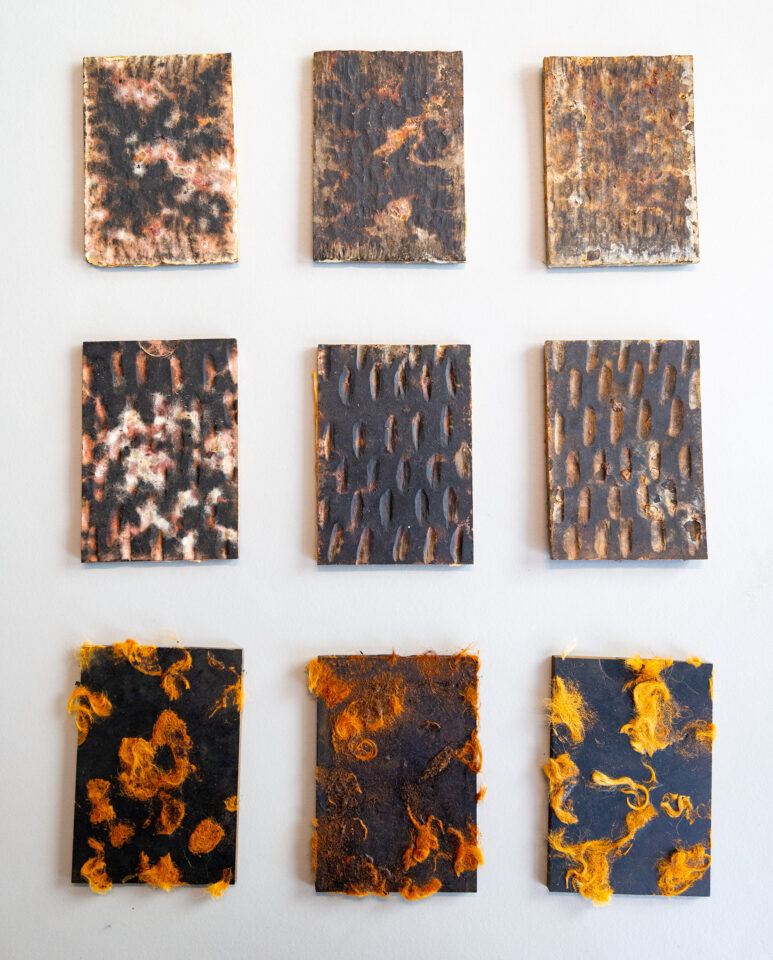
A row of black facade panels in a field barn near Oirschot is meant to look different next year. One slowly reveals the flax fibres inside it, another carries wool that develops a patina, and two invite algae or mycelium to grow on the surface. They belong to Living Traces by Isa Jansen, one of the works in Zaaien 26 – Reflecteren op morgen at Nieuw Zwanenburg.
Nieuw Zwanenburg is a field lab on a 17th-century farmstead next to the A58, where designers, farmers, researchers and Rijkswaterstaat develop biobased materials for roads, bridges and waterworks. This year’s exhibition, open from May to October 2026, brought together young designers working with flax, seeds and broomcorn, a collection of biobased samples from companies and start-ups, and projects initiated by the farm itself. Almost everything on show is research or prototype work rather than products for sale.
Facade Panels That Wear Their Age
Living Traces started as Jansen’s final master project at TU Eindhoven. Her material was N8040, a fully biobased composite made from waste streams by NPSP and sold as Nabasco 8040. Its dark resin leaves little room for colour, and in user tests the material scored low on beauty. Jansen turned the problem around. Rather than hiding wear, she designed for it.
She pressed hemp, wool and flax into the composite and added pigments from turmeric, mandarin peel and avocado skin. Sandblasting and accelerated weathering then showed how each surface might change over the years. Like leather or timber, the panels are meant to age in plain sight: dark at first, with amber fibres and pale patches surfacing over time. The panels were shown at Dutch Design Week 2025 and in MaterialDistrict’s Young Talent selection in 2026. At Nieuw Zwanenburg they sia in the sample collection, alongside companies such as NPSP.
Dyes From the Farm’s Own Crops
Anne van Strien took colour from the fields around the barn. She researched dyes from miscanthus, hemp and cup plant grown on the farm and used them in a wall hanging, Stemmen van de Aarde (Voices of the Earth). The local community was invited to donate linen clothing as raw material, and a podcast tells the story behind the textile. Van Strien was one of the designers in this year’s presentation of projects made by, for and with Nieuw Zwanenburg.
Flax, Twisted Into Rope by Hand
Back to the Flax is a collective of ten Design Academy Eindhoven students who grow, harvest and process flax on a 1,000 m² plot in Gijzenrooi, on the edge of Eindhoven. Searching for a way to spin raw fibre into yarn locally, they ended up at rope-making, one of the oldest crafts there is. Their work was shown at Nieuw Zwanenburg next to that of Studio NOF and Boyana Voynova.
The sixth chapter of Back to the Flax, devoted to cord and knot, was on show at Kazerne in Eindhoven during Dutch Design Week until 25 October. More on the field lab and its crops can be found in The Materials of Tomorrow.
Sources: Nieuw Zwanenburg / Studio Living Traces / TU Eindhoven / Dutch Design Week · Images: Isa Jansen, Nieuw Zwanenburg, Elisabeth Teje Duis