Bacterial Cellulose Skins That Shrink Into Shape
A sheet of bacterial cellulose starts as a wet, heavy and pliable membrane that forms at the surface of a liquid culture. As it dries, it shrinks, turns more transparent or more opaque, and pulls on whatever holds it. Skin Machine, developed at the AA Design Research Laboratory in London, uses that change to shape form. It is a research project, not a product.
Growing the Material Layer by Layer
The team behind the project, led in presentation by Hemant Jindal, with Arya Gupta, Muna Abbas and Zeinab Muneam, starts with the conditions in which the cellulose grows. The vessel, the growth surface and the time before harvest all become part of the design.
In the recorded cultures, the seven-day samples grew faster in darkness and needed an acidic medium. Doubling the sugar from 15 g to 30 g did not improve growth in the twelve-day comparison. The researchers stress that these are observations, not a universal recipe.
The sheets can also be built up in layers. A grid above the growth tray holds threads attached to the forming membrane. Pulling selected points lifts the first layer off the liquid, and a new layer grows beneath it and binds to it. Over twenty days, three layers developed with pockets between them.
Drying, Treatments and Moving Frames
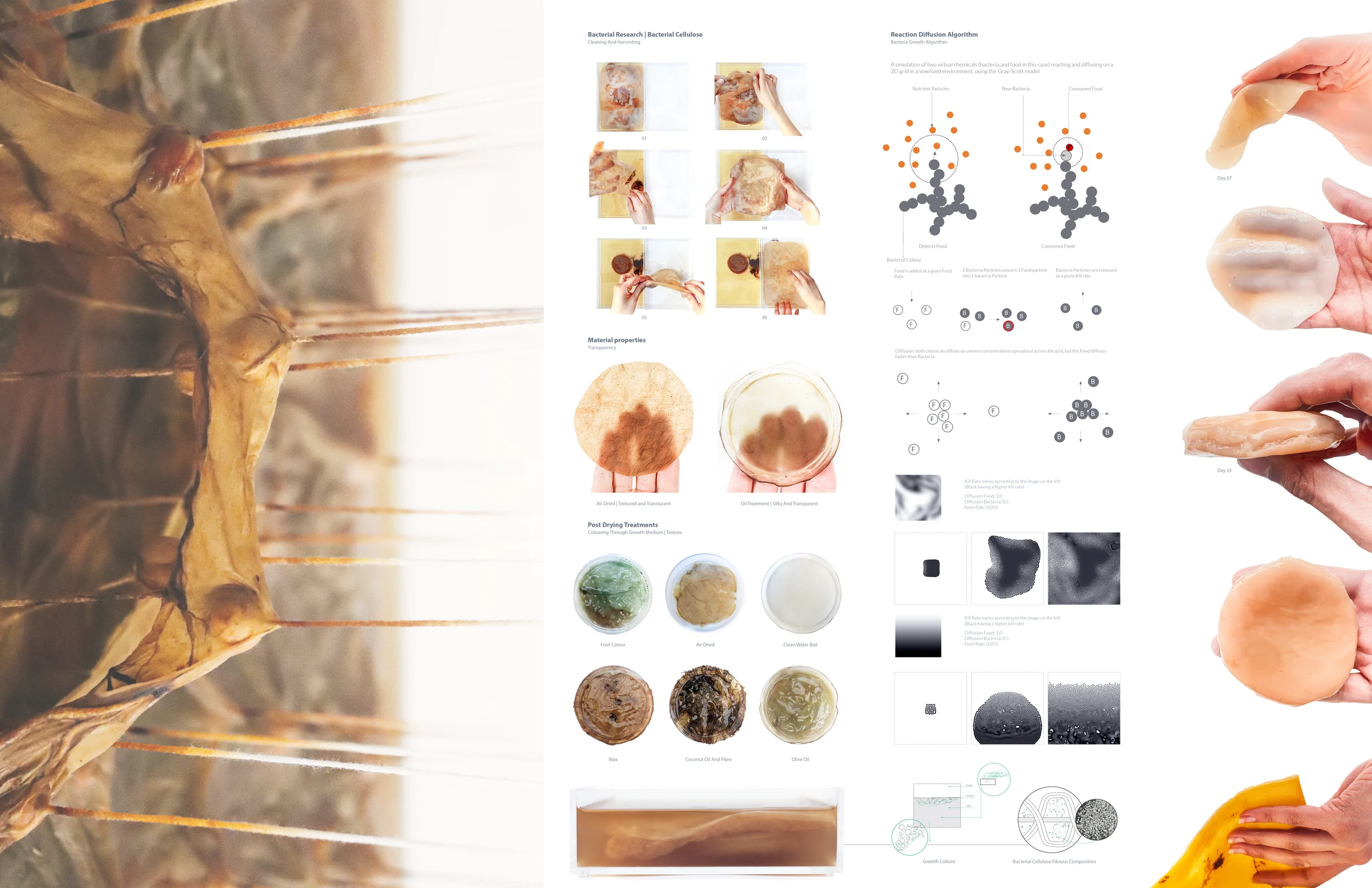
Image: Skin Machine research team
Drying changes the sheet’s outline, surface and transparency. The team compared air drying with post-drying treatments including oil, wax and varnish. Oiled sheets turn silky and transparent, while air-dried ones stay textured and translucent. Growth media
such as fruit colour tint the cellulose.
In a rehydration test, half of a dried, oil-wax-treated sheet was soaked for twenty-four hours. It gained thickness, lost transparency and released its wrinkles.
The membrane is then attached to flexible frames. The frame holds the sheet, and the contracting sheet in turn bends the frame. Experiments moved from one frame to several linked frames, with computational studies of anchor points and hinges alongside.
From Inflated Skins to a Façade Proposal
Stitching defines the boundary of a skin, and air pressure opens it into a volume. Treated and untreated specimens were compared. Stitching and smocking were also used to organise folds and join small sheets into larger assemblies.
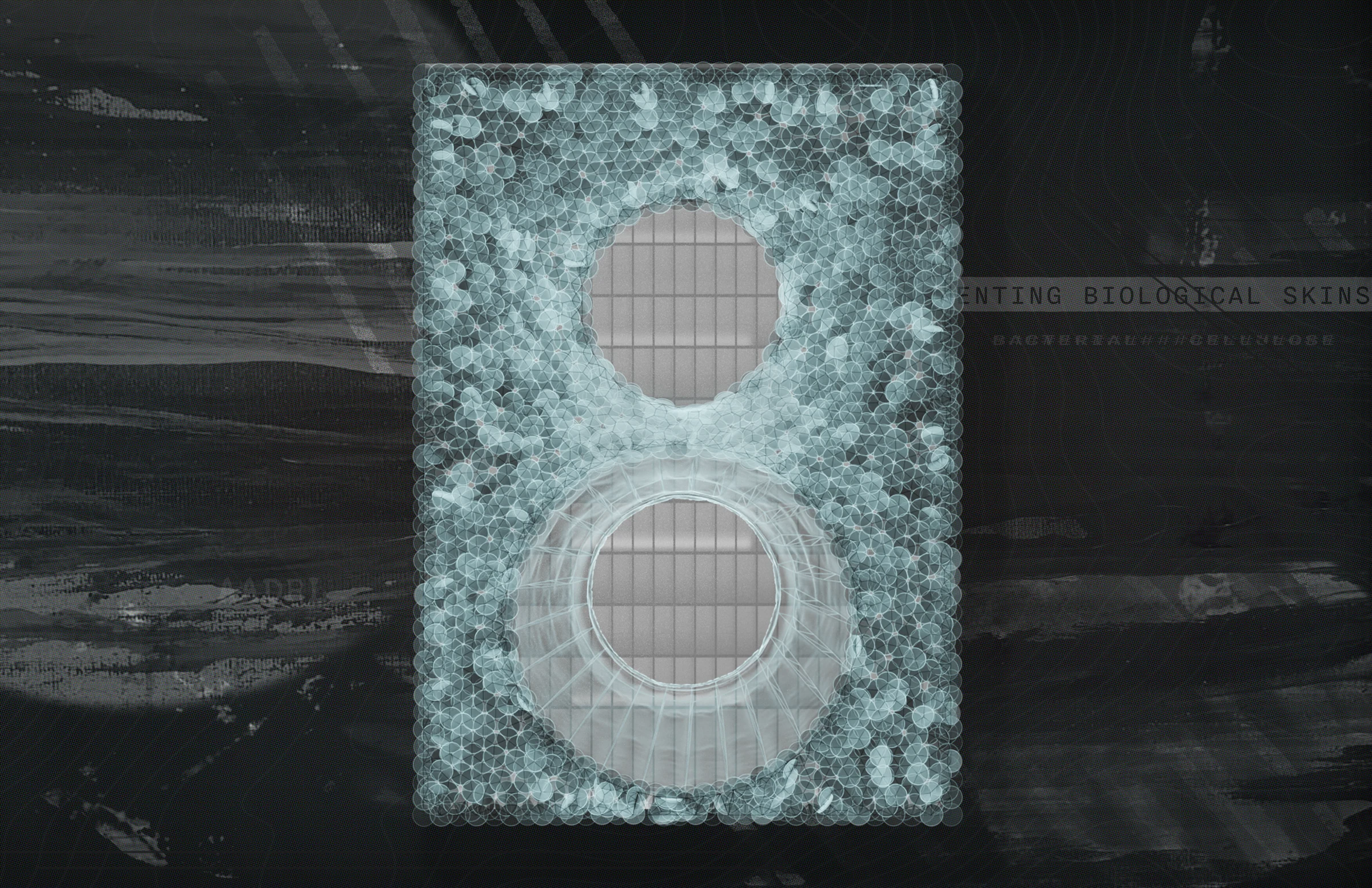
The façade image shows a cellular surface around two circular openings. It is a design proposal, not a built or performance-tested facade. The physical experiments document the material work behind it.
The full research and archive are published in Field Assembly, Issue 01.
Source: Field Assembly · Images: Skin Machine research team