Engineered Yeast Brews Purple-Blue Dye for Scarves and Cellulose
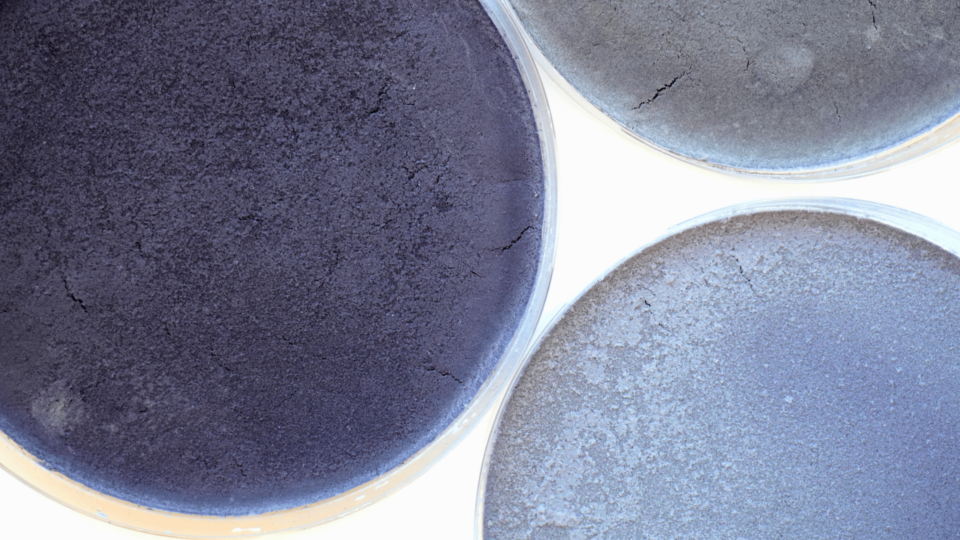
A pale purple-blue scarf, a tuft of cotton yarn and a few sheets of bacterial cellulose share one source of colour: yeast. Wageningen start-up Novya Biotech reprogrammes yeast cells so that they ferment a colourant, which is then used to dye textiles and other materials.
The pieces were on show in The Biodesign Warehouse at Klokgebouw, Eindhoven, during Dutch Design Week 2026. They are prototypes. Novya describes the scarves as the first textile product dyed with a yeast-brewed colourant, and nothing is commercially available yet. Its platform currently produces a blue-violet, with a yellow in development.
Colour Brewed Instead of Synthesised
Bakers and brewers have relied on yeast for centuries; synthetic biology lets it make other compounds too. Novya grew out of the PhD research of microbiologist Carina Nieuwenweg at Wageningen University & Research, where she worked with CRISPR-Cas researchers John van der Oost and Raymond Staals. Her team found a faster way to edit yeast DNA with CRISPR-Cas. Successful edits can be reused and stacked, so a strain can be tailored to a new molecule far more quickly than with step-by-step methods.
For colour, Novya pitches this as a third route, next to dyes synthesised from petrochemicals and pigments extracted from plants, which cost land and raw material. The starting point is a deep purple-blue mass of dried yeast. On fibre the shade turns lighter and softer: the scarves read as a pale lilac-blue.
One Colour on Four Substrates
The Eindhoven collection tests the same colourant on cotton, merino wool, polyamide and bacterial cellulose, so natural protein and cellulose fibres sit next to a synthetic one. The bacterial cellulose swatches add a second layer of biology: the sheets are grown in liquid by a symbiotic culture of bacteria and yeast, then dyed with the colour from Novya’s engineered strain.
Microbial colour has appeared on MaterialDistrict before, from bacterial pigmentation for textiles to clothes dyed with genetically engineered bacteria. Novya uses yeast as the producer instead.

Designers Wanted for Early Tests
The company is testing the market as much as the material. Its online forms ask designers, artists and brands where they would use bio-based colour – textiles, interiors, paper and print, packaging, cosmetics – and what price premium they would accept. Samples of the dyestuff, dyed yarn, fabric swatches, the scarf and dyed bacterial cellulose can be requested. The same yeast platform could later serve aromas, food ingredients and medicines; food, cosmetics and pharmaceuticals are among the markets the team is studying.
For now, Novya is looking for designers, artists and brands to experiment with its colours, and has opened a sign-up list for news of its first commercially available product.
Sources: Novya Biotech / Dutch Design Week / Wageningen University & Research · Images: Poorva Shrivastava and Carlijn Barendregt, courtesy of Novya Biotech