Directly Foamed Porcelain Becomes Water Filter and Acoustic Panel
Porcelain usually stands for density: thin, hard and glassy. Porcelain Foam turns it into a light, sponge-like mass full of air, made by foaming the liquid slip itself rather than copying a plastic sponge. Designers Charlotte Becker and Eva Conci showed the material at Dutch Design Week 2026, together with two prototypes: a water filter and an acoustic panel.
The project began as their bachelor’s thesis at Hochschule Coburg, developed with the Chair of Ceramic Materials at the University of Bayreuth and the porcelain manufacturer KOBER. It is research, not a product: the drying process is still being refined. The work received a silver DDC Award 2025 from the Deutscher Designer Club in the System Design Talents category.
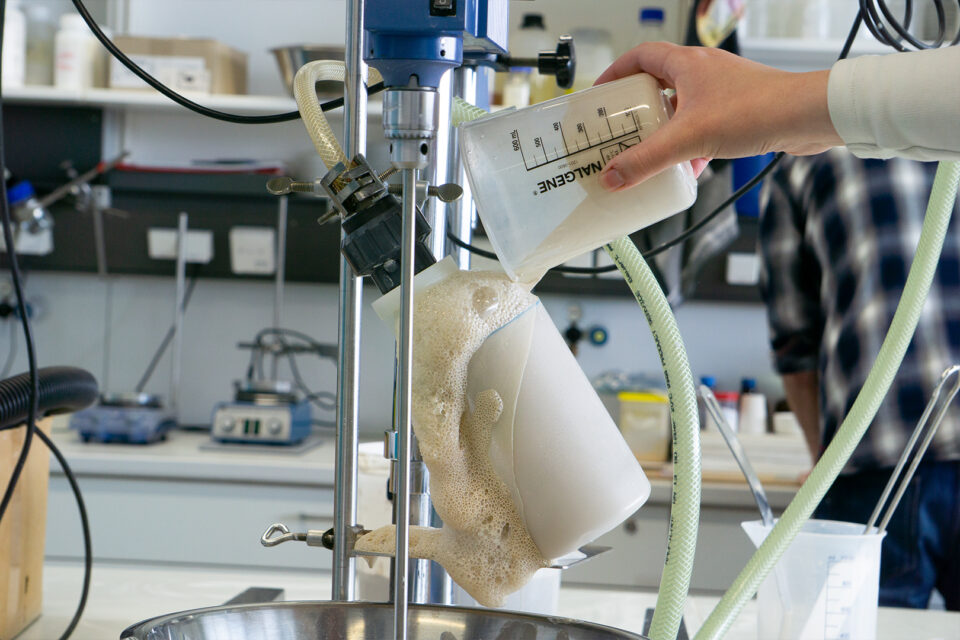
Foaming the Slip Instead of Burning Out Plastic
Conventional ceramic foam filters are usually made from a polymer template that is burnt off during firing, leaving a ceramic copy of the sponge. Becker and Conci skip that template. They introduce air straight into the viscous slip, and organic additives keep the bubbles stable while the mass sets. The DDC award text notes that avoiding the burnt-out plastic carrier reduces emissions, and the method allows continuous foam production.
Because the foam can be cast, it is not limited to flat sheets. Large-volume pieces can be fired without cracking and stay light thanks to the high air content. Pore size and overall porosity are set during production. The open pores also draw liquids in by capillary action and release them evenly. The samples on show range from rough white blocks to cups and domes, their cut faces revealing an irregular, pumice-like interior.
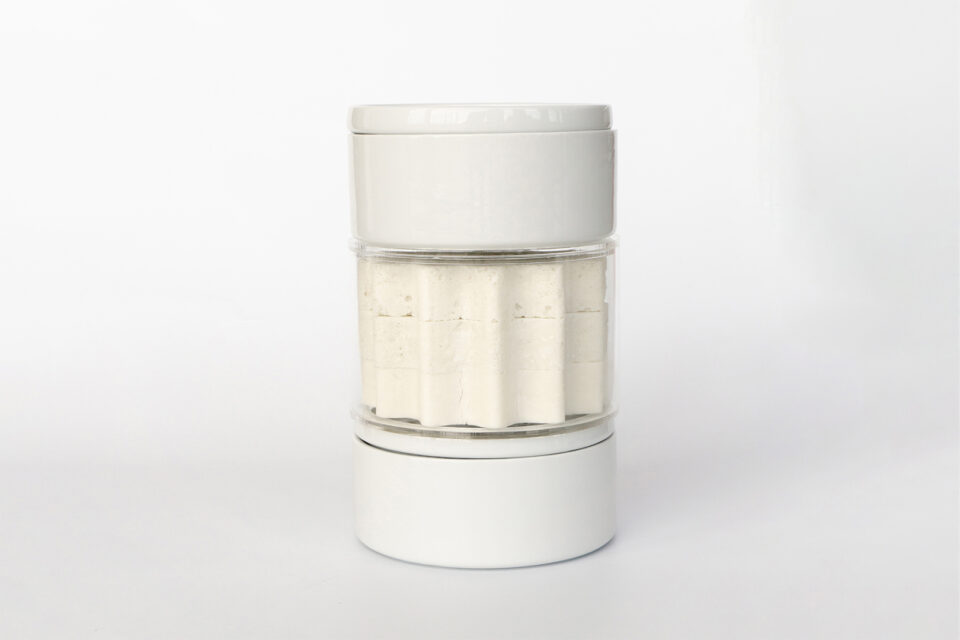
A Water Filter and a Panel for Indoor Pools
Becker’s prototype is a stacked filter. Contaminated liquid runs through small openings onto modular foam elements and collects as clean water in a vessel below. By tuning pore size and porosity, the designers report filtering contaminants down to the scale of microorganisms, from both liquids and gases, with SEM analyses supporting the results. The elements can be cleaned and reused.
Conci’s panel works as a porous absorber: sound waves entering the pores lose energy as friction turns it into heat. Faceted, carved reliefs give the white surface a quarried look. Being ceramic, the material is heat-resistant and chemically stable, and the designers state that it meets strict fire safety requirements. Its resistance to moisture points to humid interiors such as indoor swimming pools. Ceramics are entering acoustics from other directions too, as in this recycled ceramic acoustic material.
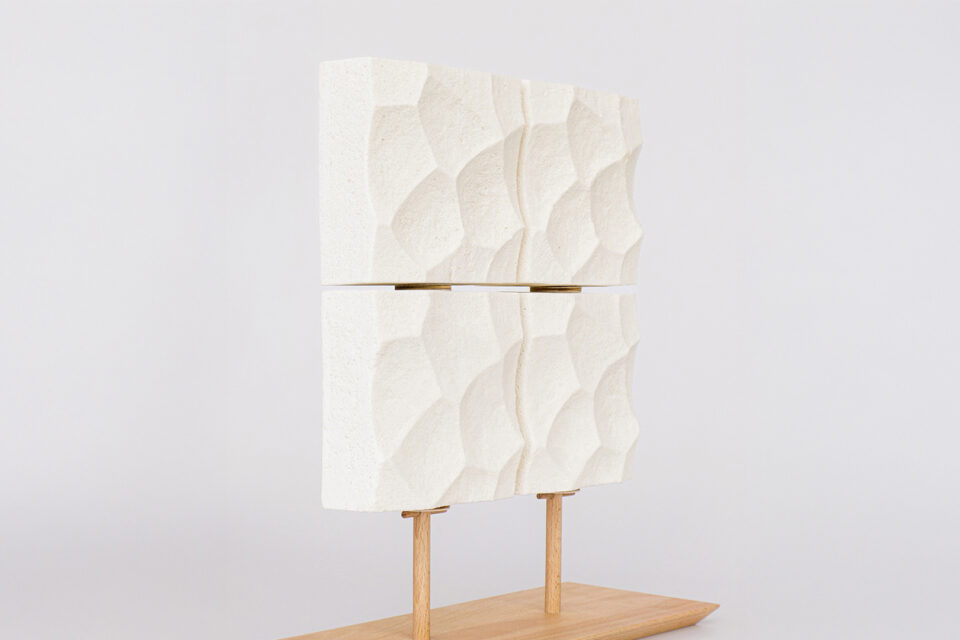
On Show in Eindhoven
Porcelain Foam – Experiment and Potential is on view in the Klokgebouw at Strijp-S, Eindhoven, daily from 11:00 to 18:00 until 25 October. The next technical step is a more reliable drying process.
Sources: Dutch Design Week / Deutscher Designer Club · Images: Charlotte Becker & Eva Conci, via Dutch Design Week