Judith Sanders Turns Willow Bark Into a Shoe
Seen from above, the pair of shoes looks like a loosely built nest: reddish-brown strands of willow bark, crossed and layered until they hold the shape of a foot. Footwear designer Judith Sanders made them by taking the bark apart fibre by fibre and reassembling it as a flexible non-woven.
They are an experimental prototype from Studio JUSA, Sanders’ practice in Helmond. She uses such pieces to start conversations about where shoe materials come from.
Turning a By-Product Into Fibre
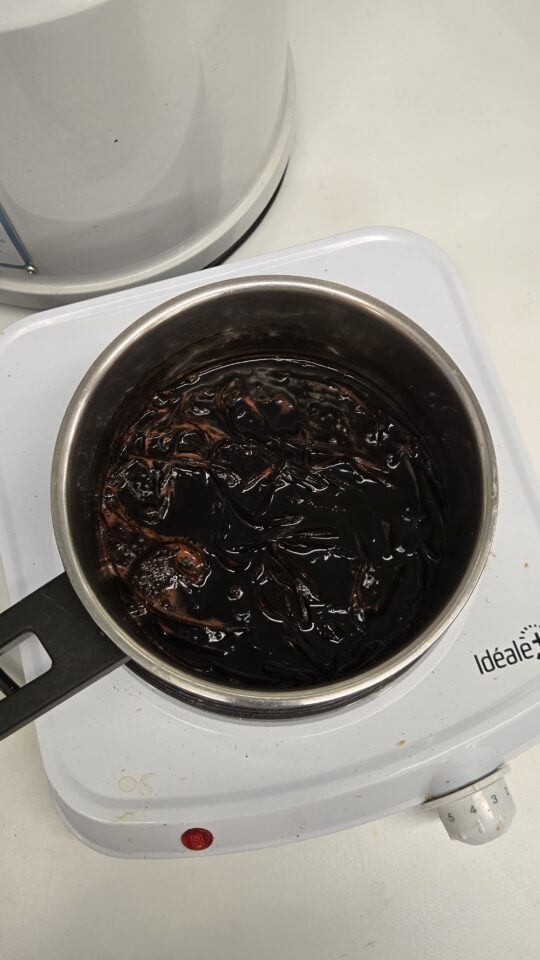
Willow is grown mainly for its wood; the bark is usually burned for energy. It is also stiff and hard, and only softens after soaking, because lignin and pectin bind its fibres together. Sanders’ willow method is close to a kitchen recipe. She removes the dark outer bark, slits the stem lengthwise and peels off the inner layer. That bark is boiled for an hour with baking soda, about a tenth of its weight, which breaks down the pectin. After rinsing, the fibres are separated by hand.
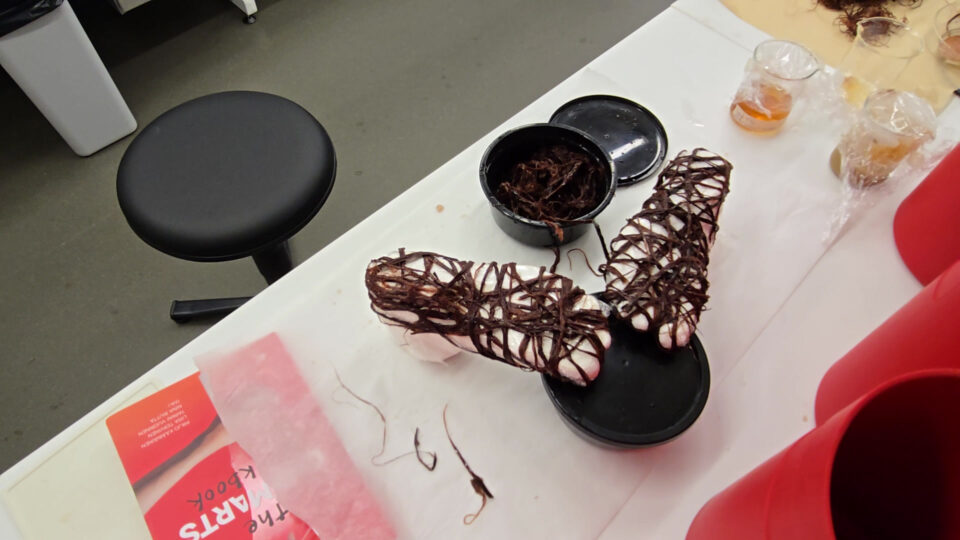
To turn loose fibres into a material, she soaks them in glycerol and carboxymethyl cellulose (CMC), drapes them over a mould and presses them down firmly. Once dry, the bark forms an open, non-woven shell. The surface stays coarse and fibrous, with gaps where strands cross, in a warm brown that comes from the bark itself. Boiling willow is not new – students in Iceland used only heat and water to make willow paper – Sanders adds a binder so the fibres hold a three-dimensional form.
Letting the Foot Shape the Shoe
Sanders spent years in commercial footwear, at ECCO shoes and ECCO leather, and now develops footwear at Bata. In her own time she looks for local, low-impact alternatives to the globally sourced, often petroleum-based materials in most shoes. For her Research Master in Design at Willem de Kooning Academy, she visited a basketry artist, taxidermists, traditional tanners and designers who work with human hair, and translated each craft into a prototype.
Fit matters too: standard lasts are averaged and often shaped by fashion. Sanders measured how much feet lengthen while walking and found differences of 10 to 25 millimetres. Her research shoes are therefore built on her own feet, a 3D-printed copy of them or a barefoot-style last.
The Sole Is the Hard Part
Sanders is frank about the limits. Her published research concludes that local materials can readily replace the upper, but the sole is far harder: of the materials she tested, only leather worked for a complete shoe. Other designers are working on biobased footwear too, for example with tulip poplar and recycled wool.
Her next steps, she writes, are a wider range of materials, a closer look at soles and research that ends in wearable shoes. Until 25 October the willow pair stood in WOW NATURE at De Fabriek in Eindhoven, alongside work by makers such as Natasja van der Meer, whose WaterLand furniture uses Dutch reed and fallen wood.
Sources: Studio JUSA – Willow / Studio JUSA – Publication / Studio JUSA – About / Dutch Design Week – WOW NATURE · Images: Studio JUSA