Bacteria Grow Compostable Foams, From Soft to Rigid
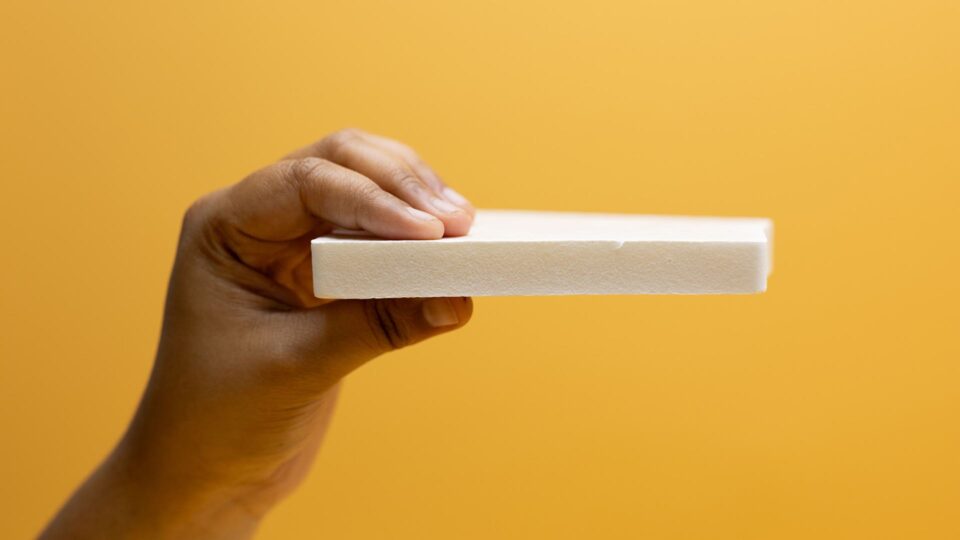
A slab of white foam that barely registers in the hand, grown in trays of fermenting liquid rather than blown from oil. Delft start-up Foamlab makes it from bio-nanocellulose, a material produced by bacteria, and can tune it from soft and sponge-like to rigid enough to bear a load.
The company showed its latest foam samples in The Biodesign Warehouse, an exhibition curated by Emma van der Leest at Klokgebouw during Dutch Design Week 2026 in Eindhoven. Foamlab is still pre-commercial. In April 2026 it raised €3 million to build a pilot plant, and it is working towards a first commercial product in 2028.
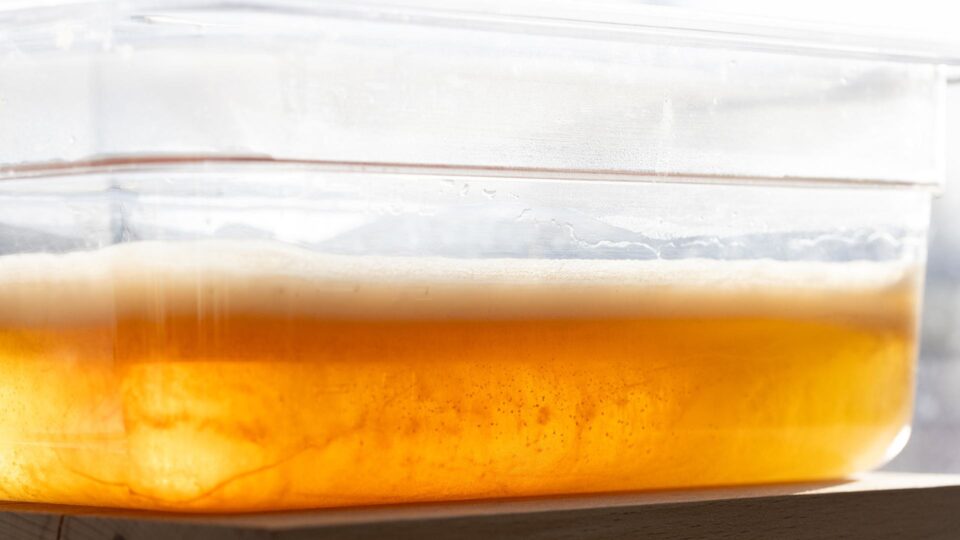
Cellulose Grown the Way Beer Is Brewed
Most cellulose comes from trees. Foamlab’s grows in a fermentation broth, where microorganisms spin a dense, very pure network of nanofibres – the company likens the process to brewing beer. That highly porous structure keeps the foam light while still giving it strength. No synthetic binders, crosslinkers or petrochemical inputs are added; density, softness and stiffness are set during fermentation and drying.
At the soft end are compressible foams that can be twisted, folded or wrapped without tearing. Denser grades are impact-resistant and hold their shape, comparable, in Foamlab’s words, to moulded fibre, cork or polystyrene. The material can be moulded into three-dimensional parts, ground into powder or beads, or applied as a coating. Figures for density, strength or thermal conductivity have not been published yet.
A White Canvas for Packaging, Acoustics and Insulation
Without binders the foam is naturally bright white, so it takes natural dyes, textures and relief patterns well. Foamlab names protective packaging, acoustic padding, moulded objects and insulation as uses, and lists furniture, textiles and footwear, cosmetics, aviation and automotive among its target sectors. At the end of its life the foam is meant to biodegrade. The company calls it compostable but does not cite a certification.
Bacterial cellulose has turned up on MaterialDistrict before, for instance as the insulating layer of a solar-powered refrigerator. Plant-based nanocellulose aerogels target a similar insulation market from another starting point.
From a Delft Lab to a Pilot Plant in Bleiswijk
Foamlab began as the first spin-off of the Biodesign Lab at TU Delft’s Faculty of Industrial Design Engineering and launched in 2024 with €500,000 in seed funding. It was co-founded by design professor Elvin Karana, now CTO, and CEO Jeroen van Rotterdam.
The €3 million round was led by ICOS Capital, with Value Factory, Stichting DOEN, Capricorn Industrial Biotech Fund and TTT Green Tech Fund, managed by SHIFT Invest, as co-investors. The money goes into a pilot factory in Bleiswijk, where Foamlab plans to scale up production and supply its first customers. Capacity and an opening date have not been announced. Until 25 October the samples are on view in Eindhoven; the next step is the move from Delft lab trays to pilot-scale production.
Sources: Foamlab / Dutch Design Week / TU Delft / Capricorn Partners · Images: Foamlab B.V.