Robots Melt-Draw Textile Fibres Directly Onto The Body
A robot arm moves around a person’s forearm and leaves a pale web of fine strands behind. No scan, no pattern, no sewing. The InSituWear project, from the Critical Matter Group at MIT Media Lab, melt-draws low-temperature thermoplastic microfilaments, among them polycaprolactone (PCL), straight onto the body.
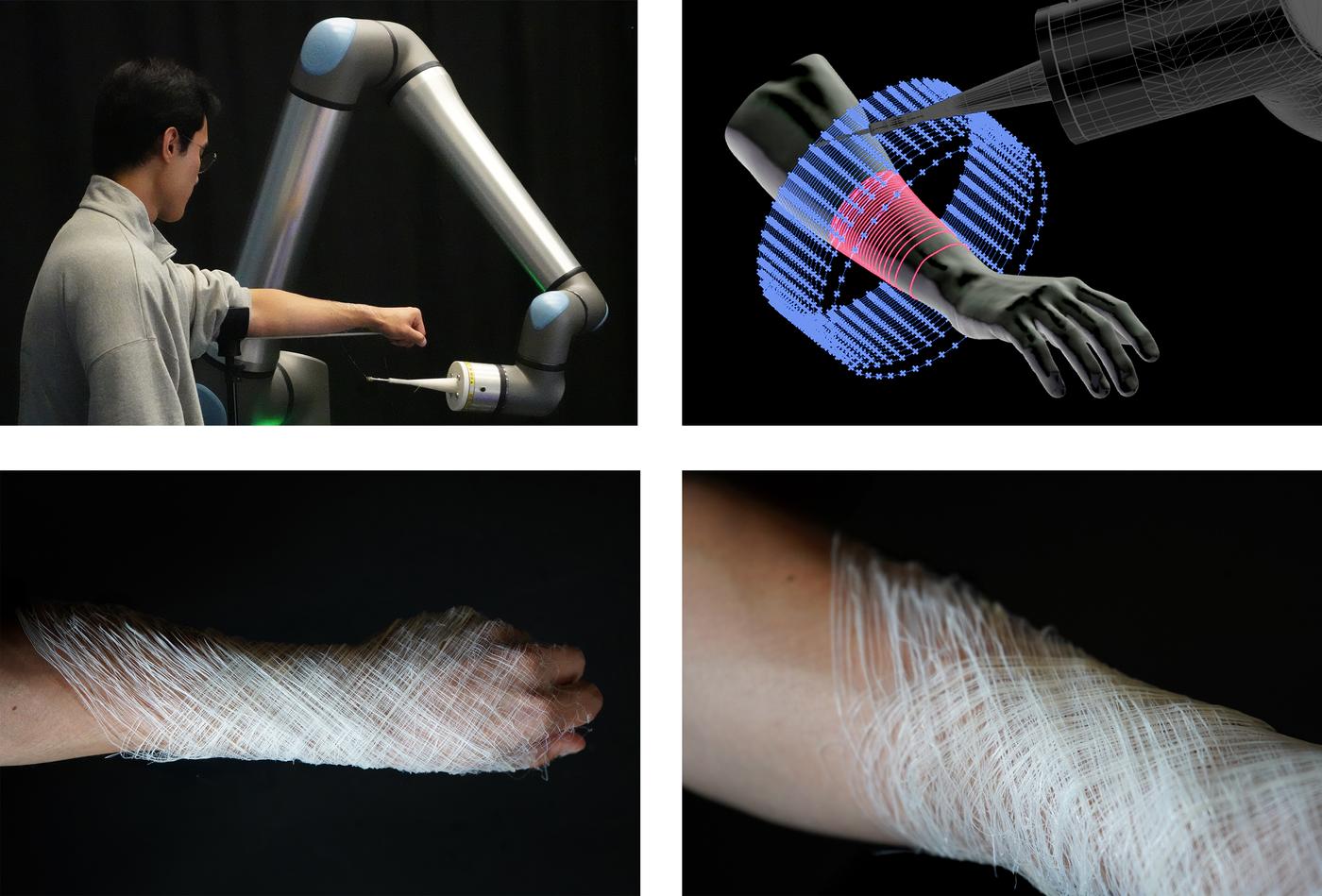
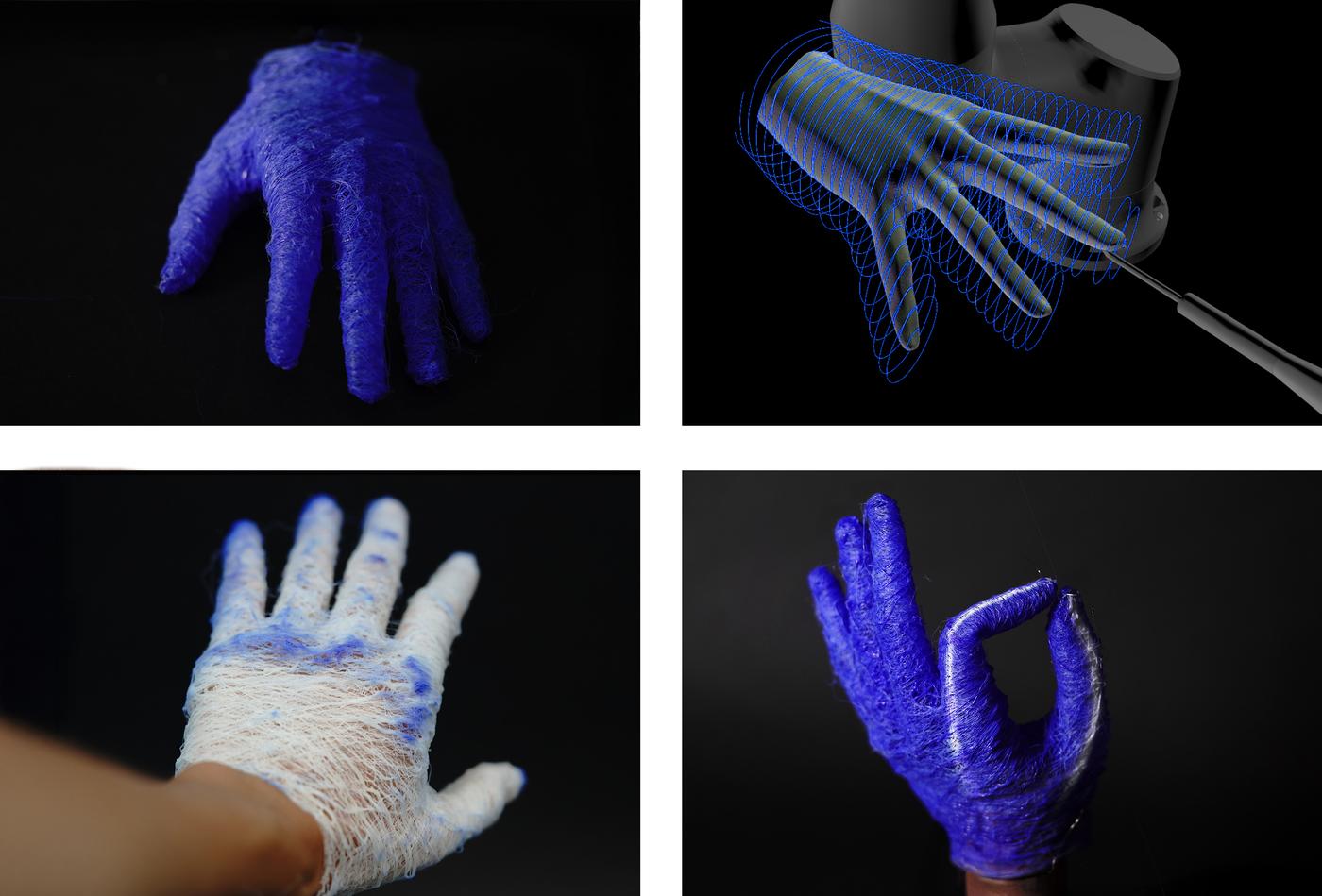
The group, led by Behnaz Farahi, published the work in 2026 as a research project. Everything shown so far is a prototype: a sleeve and a glove made on volunteers. The aim is custom-fit, waste-free textiles that take their shape from anatomy and movement rather than from a predefined model.
A Robot That Draws Fibre From Molten Plastic
The method rests on a bespoke computational pipeline. It defines a rough body geometry, safety boundaries, toolpaths and clash detection, then runs the robot in one workflow. Interchangeable single- and multi-needle tools, with local heating and some compliance, dip into molten material and pull it out as filament.
To understand the fibre, the researchers ran pull-out tests at fixed dip depth and pull height. Pulling speed and material mix decided the diameter. In the microscope images, plain PCL gave strands of roughly 0.08 to 0.11 mm. Mixes with 2.5 or 5.0 per cent thermal or UV powder produced anything from 0.03 mm to 0.42 mm, depending on speed.
The tests were run at 100, 300 and 500 mm/s. Faster pulling made thinner fibre, a tunable link between computation and material.
Parallel, Crossing And Diagrid Wraps
On cylindrical test forms the team wrapped fibre in three families of pattern: parallel lines, crossing lines at 30 or 45 degrees, and diagrids with low or high counts. Spacing ranged from 1 mm to 25 mm. The results look like gauze or cobweb, from loose veils to dense, almost felted sleeves, and the pattern governs how well the strands hold together.
According to the researchers’ tensile tests, the melt-drawn textiles fall within the mechanical range of common commercial fabrics. These are the team’s own claims and have not been independently confirmed.
A Glove That Reacts To Heat And Touch
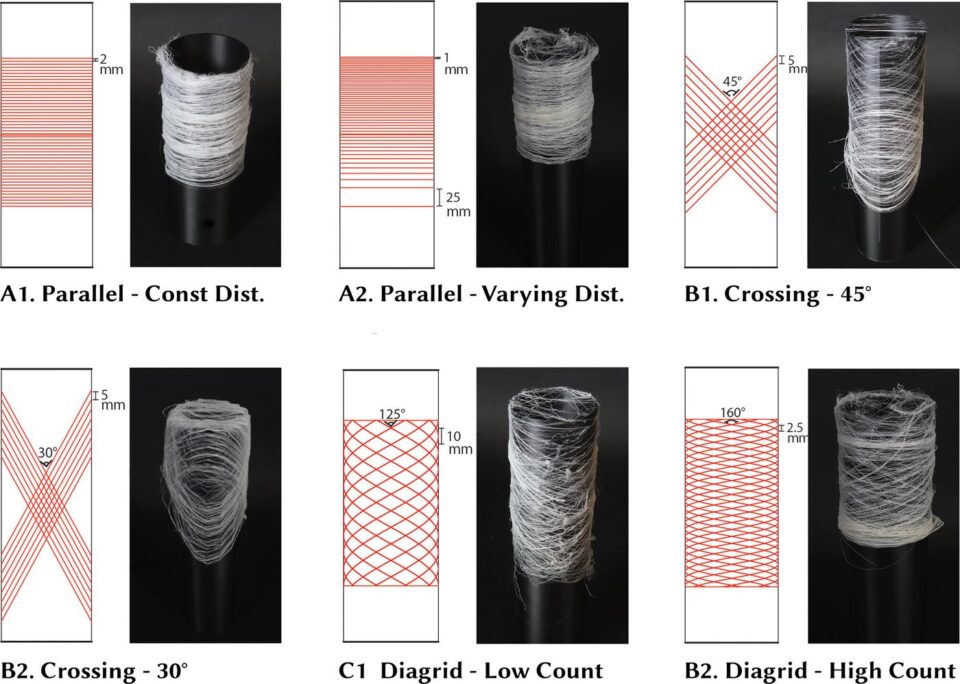
Image: Critical Matter Group, MIT Media Lab (CC BY-NC 4.0)
The glove prototype uses thermochromic PCL and embedded nichrome wires. Hand gestures trigger local heating, and the fibre changes colour, turning from white to blue in patches. The responsive behaviour sits in the fibre network itself.
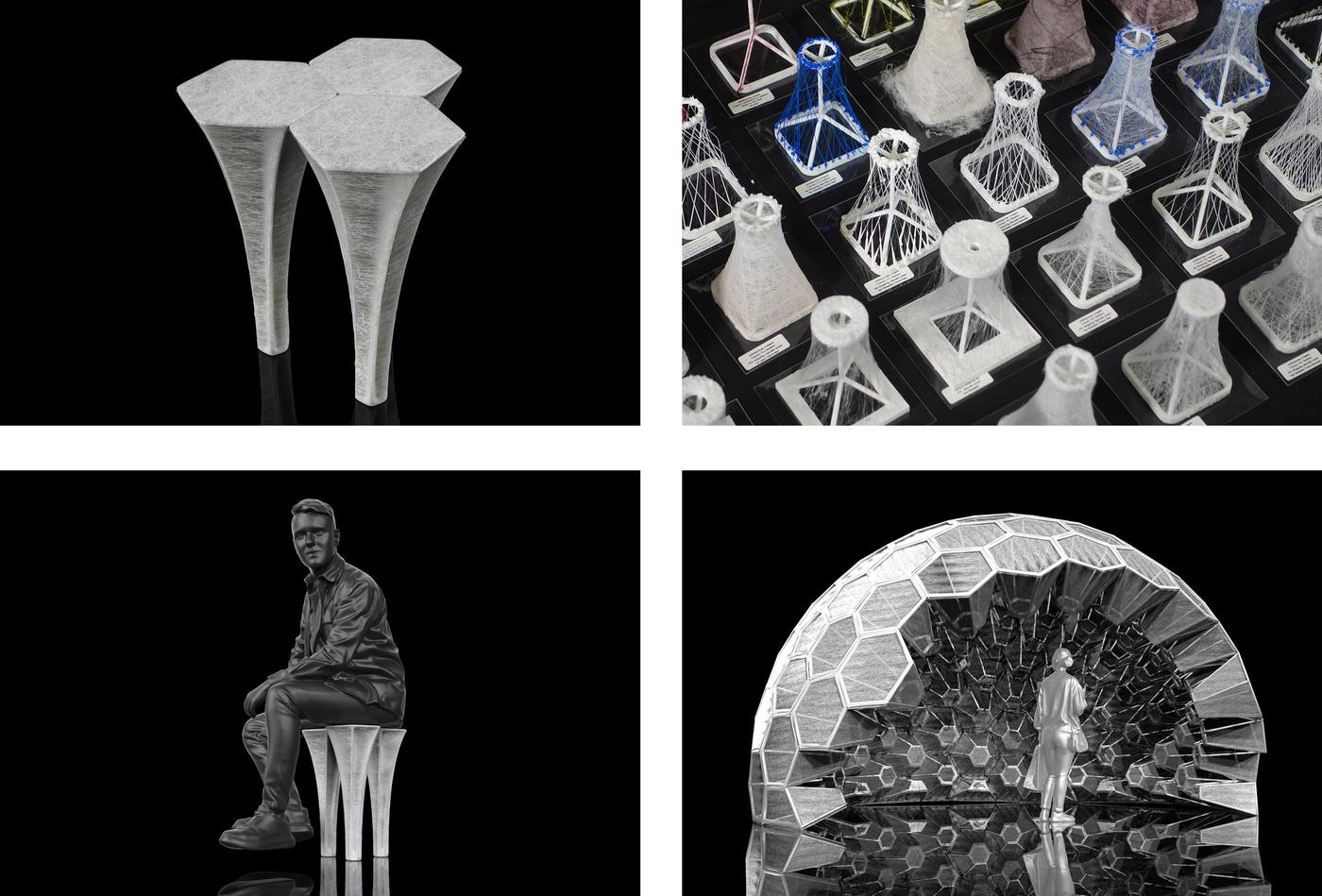
The team also wrapped open 3D frames, producing lightweight stools and domed structures in scale models that can be reinforced for strength. Furniture and architecture remain a suggested direction for now. The next steps have not been announced; the project page credits support from the MIT–LUMA Grant.
Source: MIT Media Lab · Images: Critical Matter Group, MIT Media Lab