Sara Farha and Khaled Shalkha Turn Date Pits Into Pavers
On 28 October, Dezeen revealed the winners of the Dezeen Awards. Amongst them was Datecrete, invented by Datecrete Studio & Lab, the practice of Sara Farha and Khaled Shalkha. This material was the public vote winner: Material innovation of the year 2026.
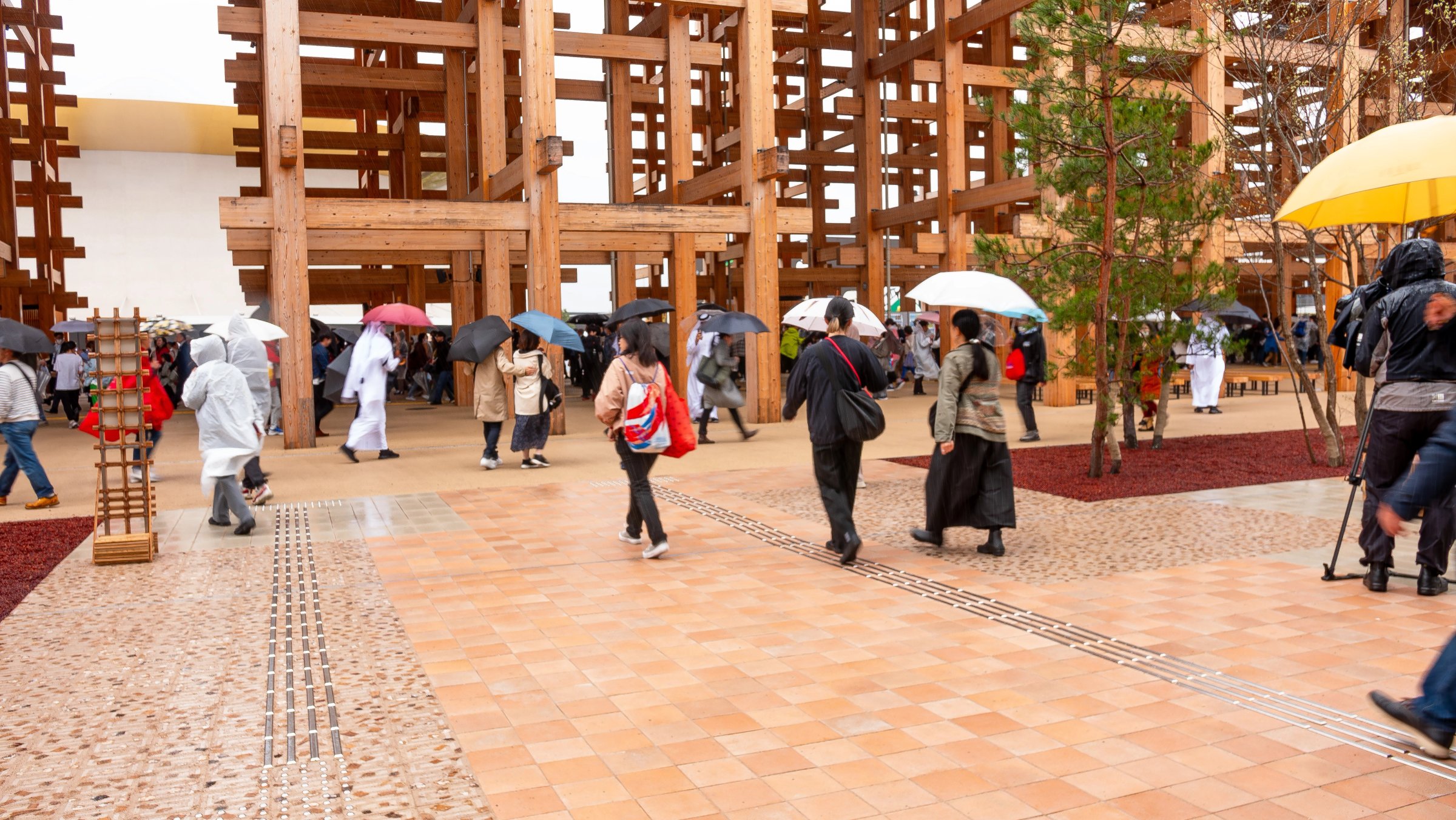
At the UAE Pavilion of Expo 2025 Osaka, visitors walked across 35 tonnes of pavers made from the patent-pending material made from ground date pits and a natural binder, without cement or resin. Half were tinted in four shades of sienna; the other half held the most fibrous part of the palm frond. The pavers for Osaka were made by hand in the UAE, for a landscape plan by SLA Architects, at the same Expo that featured the timber Grand Ring.
Starting From the Date Palm
The research began in 2022, during the Tanween programme of the design platform Tashkeel. The MENA region produces millions of tonnes of dates a year, and the pits are mostly thrown away. Like wood, they contain cellulose, lignin and hemicellulose. The designer pair read the scientific literature, studied historical binders from the region and then tested roast times, drying methods, particle sizes, mix ratios and curing conditions one by one. Early experiments looked at how oven-roasting changed the colour, structure and binding of the seeds.
Today, the pits come from local date-processing factories. They are dried, roasted and ground into a fine powder, mixed with the binder, cast into moulds, cured and finished. The palette runs from misted yellow and sienna to brick red, chocolate, emerald green, steel blue and charcoal, in matte or glossy finishes. Pits are not new as a raw material for panels: Pit-Board uses olive pits with a bio-resin.
Tested Like a Building Material
Farha and Shalkha publish their test results to ASTM standards. Datecrete reaches a compressive strength of 23.8 N/mm² and a flexural strength of 6.17 N/mm², at a density of 1,650 kg/m³. It has a Class A rating for surface burning, and after 500 hours of UV exposure the samples showed no cracking or colour change. The studio casts it into tiles, panels, furniture and sculptural objects.
From Bee Hotel to Shop Floor
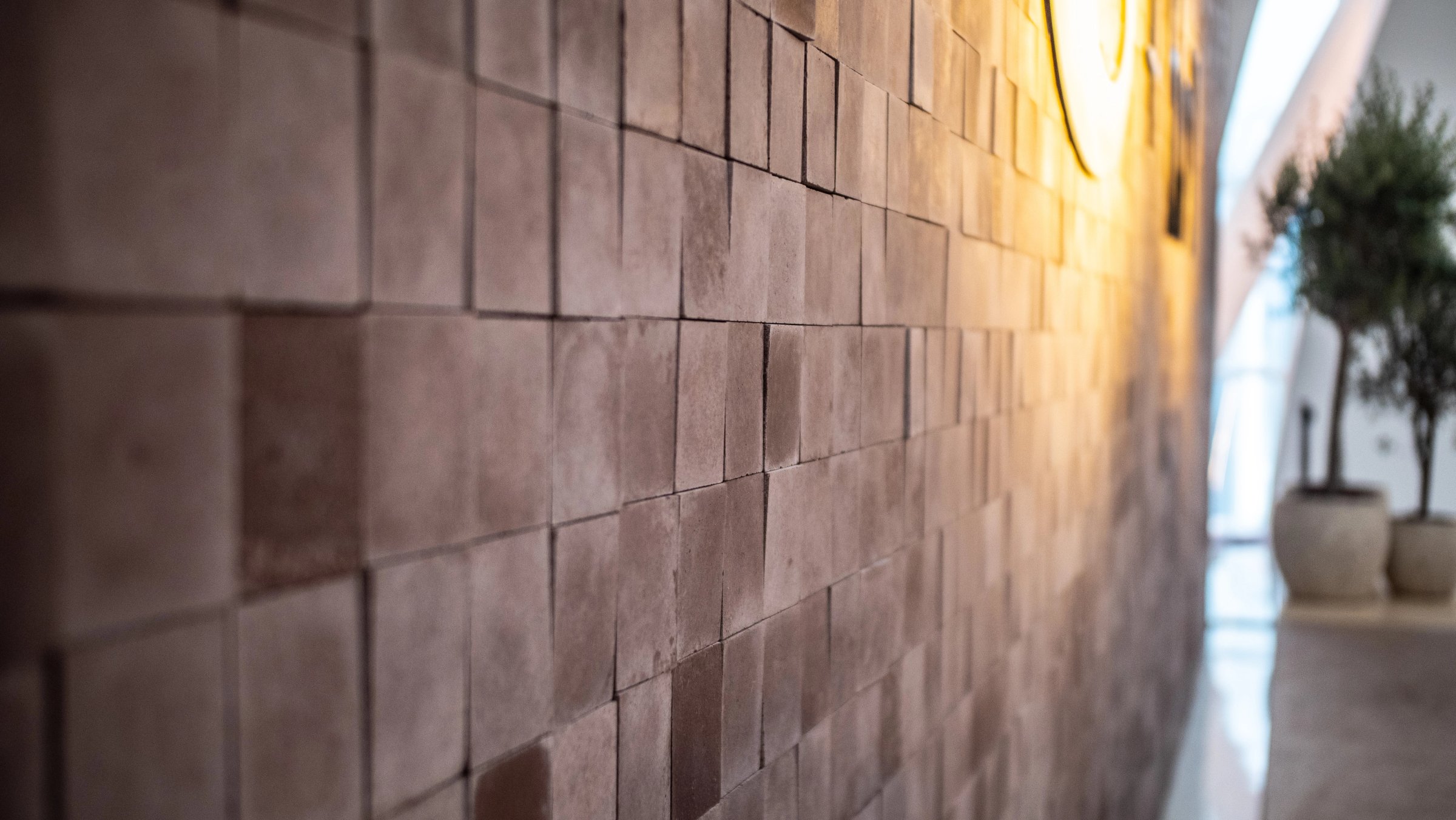
Their work moves between art and architecture. The Datecrete Bee Hotel, a habitat for solitary bees and wasps developed with biologist Nico Pantaleoni of SLA, was unveiled at Abu Dhabi Art in November 2024 after the duo received the Christo and Jeanne-Claude Award. In 2025 the studio supplied 90 m² of sienna floor tiles for the Climate Tribe Hub, ribbed chocolate tiles for KLAY, designed by TEE VEE EFF, and a tiled backdrop for a BKRY pop-up that also showed early prototypes with wheat and cocoa husk waste.
The studio takes enquiries for custom formats and sells a sample box, itself made of Datecrete, that holds up to 13 textures and finishes.
Sources Datecrete Studio & Lab / Dezeen
Photos: Datecrete Studio & Lab