Clara Mu He and Henry Chung Swap Nails for Straps
A timber wall and bench at Harvard University hold together without a single nail or screw. Straps clamp the wooden members against friction pads, and once the straps are released, every piece comes away intact. The system, Project (Un)Build, is the work of Clara Mu He and Henry Chun Tak Chung.
He and Chung, both at Harvard University, published the method as a peer-reviewed paper in the journal TAD (Technology | Architecture + Design), volume 9, issue 2, and present it on the Project (Un)Build website. Their starting point is waste. Citing US EPA figures, they note that construction and demolition in the United States produced about 41 million tons of wood waste in 2018, of which only 9 per cent was recycled and 73 per cent went to landfill. Nails, screws and adhesives make clean separation slow and damaging, so sound timber is often thrown away.
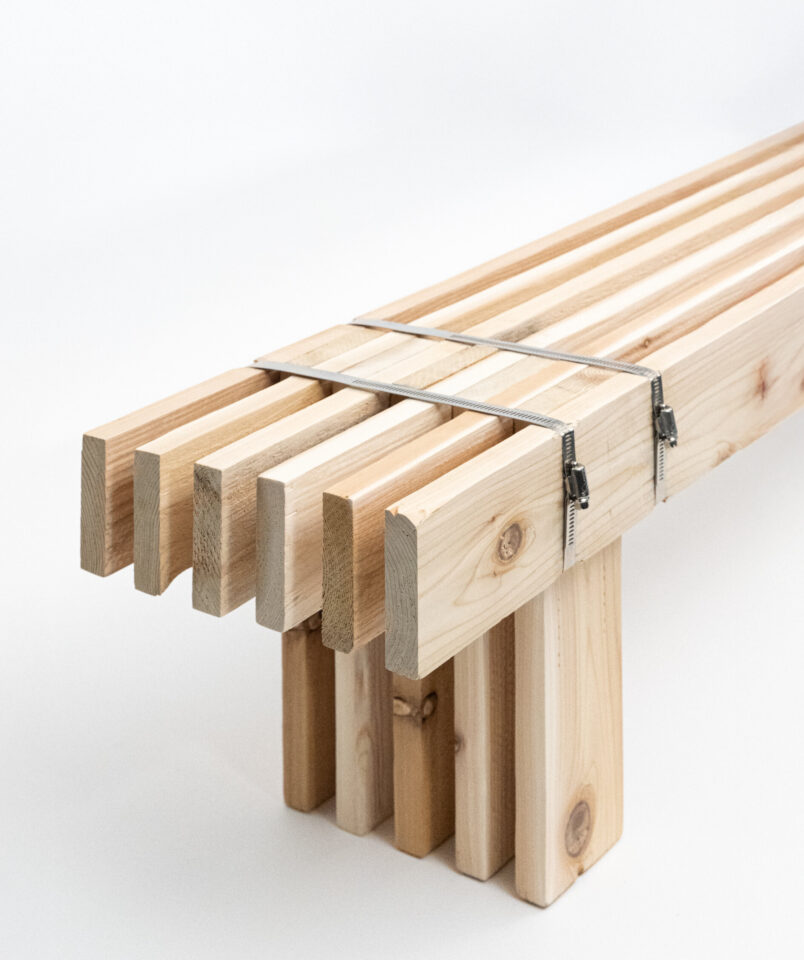
Friction Instead of Holes
The joint has two parts: a strap and a friction pad. Wood members are wrapped in tensioned straps, and double-sided pads sit between all surfaces that touch. Tightening the strap presses the wood against the pads, and friction holds the joint. Straps can be polypropylene, PET or steel. For load-bearing joints the designers recommend metal plates with small teeth of 1–2 mm on both sides; for joints that mainly resist lateral loads, coarse double-sided sandpaper works. The method suits sawn timber as well as LVL, glulam and CLT, and uses standard industrial strapping tools.
In load tests on red oak specimens, strapped joints held 1.0 short ton (0.91 tonnes) perpendicular to the grain and 0.8 short ton parallel to it. A bolted joint reached 0.9, a screw 0.2 and nails 0.1. The authors present these as approximate, preliminary values.
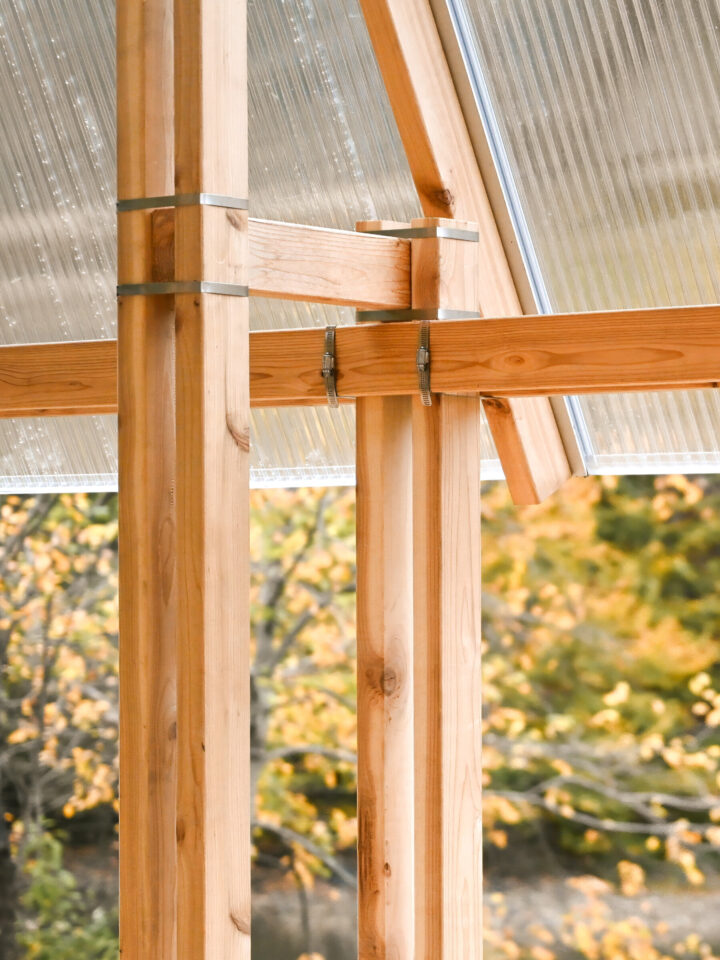
Two Prototypes, Every Piece Recovered
The first prototype, six frames each 2.4 metres long and high, used poplar, stainless steel cable ties and 40-grit sandpaper as friction surface. After its exhibition it was dismantled simply by removing the straps, and all material was reclaimed. The second, an exhibition wall 2.4 metres high and about 6 metres long, used hose clamps, hardwood and toothed metal plates at the corners, with plywood sheathing strapped on. Soft poplar dented at the corners when the straps were tightened; hardwood solved this, and the plates left only light marks that sand away.
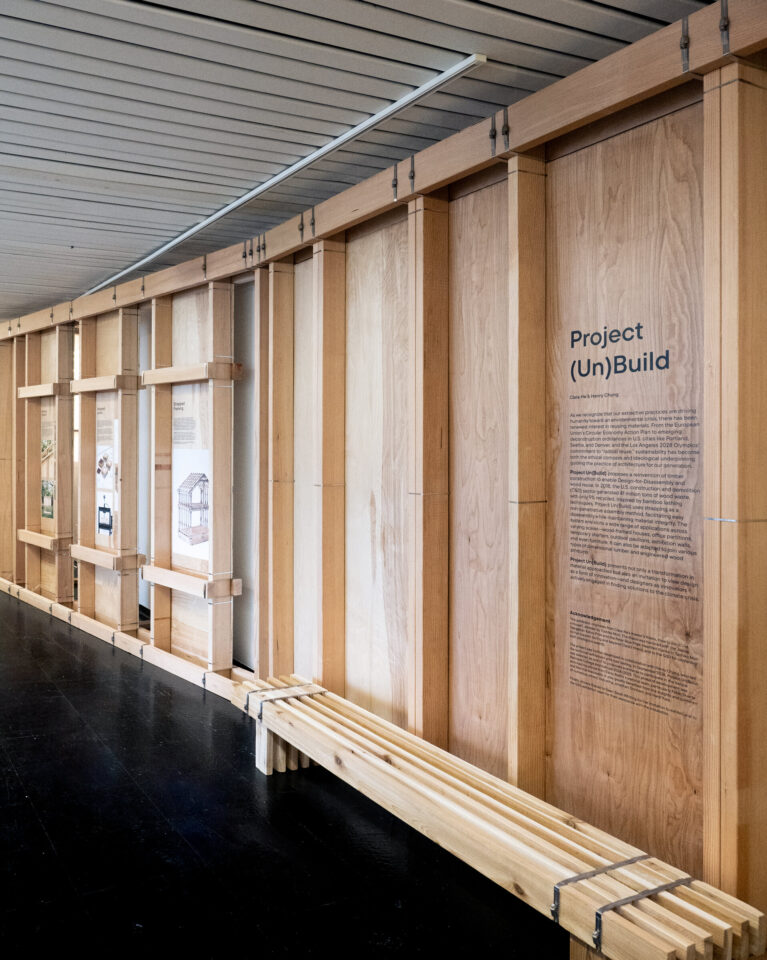
The two are clear about the limits. Strapped timber cannot yet replace nails in insulated multi-storey buildings, and its durability under changing moisture and temperature still has to be tested. They see it for partitions, exhibition walls, pavilions, decks and furniture, alongside other circular approaches such as mapping the materials stored in existing buildings. Project (Un)Build is now seeking industry and academic partners for demonstrators and pilots, and is running further tests towards engineering validation and certification.
Source & images: Project (Un)Build / He and Chung, TAD 9:2