Robotically Sprayed Earth Forms a Noise Barrier Without Steel
At the InnovA58 test site near Oirschot, a stepped, sand-coloured wall has shown that a noise barrier can do without steel. It is sprayed from earth by a robot, and its maker, the start-up Terrestrial, now wants to build it by the hundred metres along Dutch railways.
Terrestrial, founded by Jelle Feringa and previously called FormWork Robotics, is based at Nieuw Zwanenburg, the biobased fieldlab in Oirschot that works with Rijkswaterstaat. Its prototype passed a field test in the InnovA58 living lab as part of the Innovatiepartnerschap Duurzame Geluidschermen (IPDG), a programme run by ProRail with Rijkswaterstaat. In a fact sheet published by ProRail, the barrier’s environmental cost indicator (MKI) is put at €3.62, against €33.02 for the reference barrier: around 11 per cent.
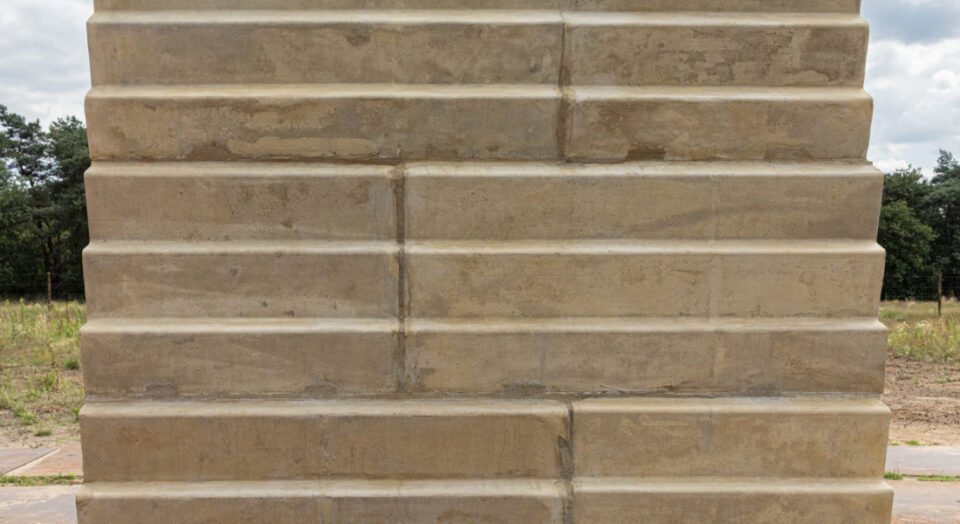
Shot Earth Instead of Rammed Earth
Rather than compacting soil in formwork, or extruding it like most 3D printed earth, Terrestrial sprays a mix of sand, clay, gravel and a stabiliser at high pressure, building the wall up layer by layer. The surface keeps that trace: horizontal bands with soft, slightly irregular edges, in the warm ochre of the soil itself. Part of the material can come from excavated soil elsewhere; earthmoving firm Van de Beeten supplies spoil from other projects, and Mavro works on a treatment that makes the surface water-repellent and resistant to graffiti.
The profile was calculated with Summum Engineering so that the wall never comes under tension, even under wind load or the pressure wave of a passing high-speed train. That removes the need for reinforcement, anchors and a concrete foundation. The wall sits on a bed of recycled mixed granulate with a geogrid, which drains rainwater and stops moisture from rising into the earth. At the end of its life, the wall can go back into the ground.
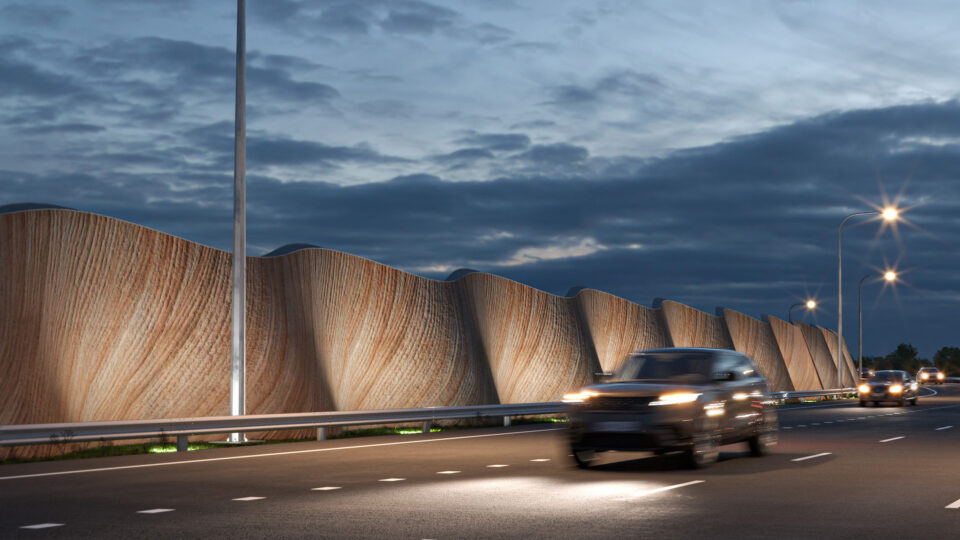
A Profile Tuned to Sound
The stepped, tilted face is not decoration. It reflects sound downwards onto the track ballast, which absorbs it. The ProRail fact sheet gives a sound insulation of 36 dB and an absorption of 5 dB, more than the required classes. For a longer stretch, Summum designed a serpentine version for the Rotterdam ring road, with curves that recall 18th-century ‘crinkle crankle’ brick walls.
Terrestrial is not the only earth-and-clay maker working around Nieuw Zwanenburg. During Dutch Design Week 2025 the farm showed a small exhibition of noise barriers with work by Terrestrial, Natrufied and Urban Reef, the Rotterdam studio known for 3D-printed ceramic habitats such as the Wall Reef. Natrufied’s miscanthus barrier Zachtzicht, the winner of a Rijkswaterstaat challenge, is now being tested as a mock-up on the same site.
Scaling Up to 130 Metres
The next step is a larger one. In the third phase of the IPDG, Terrestrial is developing a prototype wall of 130 metres, with support from ProRail and with Summum, Van de Beeten and Mavro as partners. The start-up has not said where or when it will be built.
Sources: Terrestrial / ProRail fact sheet / Summum Engineering / Nieuw Zwanenburg · Images: Terrestrial, Summum Engineering